Know you blogger

My photo
Vellore, Tamil Nadu, India
I'm a frood who knows where his towel is.
Showing posts with label University of Virginia. Show all posts

Thursday, July 21, 2011

The fearsome face of leprosy in India


Date: 07/21/2011


Being fond of superlatives, I use horrifying and terrifying quite flippantly and usually in a comic context. After meeting a patient with leprosy in one of the community health screenings, I decided to google the following term: “Leprosy pictures”. When I describe those pictures as horrifying and terrifying, I don’t believe that is an overstatement at all and humour is very far from my mind. As I browsed through the pictures of the faces and bodies marred by leprosy, they seemed a hybrid between a monstrous phantasm and a human. Indeed, the disfigurment of the face due to leprosy is described as leonine facies (lion face). Seeing this made the aetiology of the stigma and the mistreatment associated with leprosy perfectly clear to me. It was fear.  

A quick internet search about leprosy produced this article: http://southasia.oneworld.net/Article/laws-in-india-criminalise-leprosy

It contained a list of the anachronistic laws in the Indian constitution related to leprosy. Most of them date from the British Raj when leprosy was considered highly communicable and incurable. In fact, leprosy is immensely treatable and is not easy to contract since about 95% of us are naturally immune to Mycobacterium leprae, the bacterium that causes leprosy. In fact, 90% of the cases of leprosy in India are tuberculoid which is not as infectious as the infamous lepromatous leprosy. I’m still in the process of checking whether these laws are  in effect or not.The key points are as follows. Leprosy patients in India cannot:
  1. Get a driver’s licence.
  2. Ride in a train.
  3. Compete in local elections.
Moreover, numerous marriage laws pertaining to hindus and muslims consider the contraction of leprosy as just grounds for the dissolution of marriage. Considering the fact that leprosy tends to be a disease of the poor and the abandoned, these laws are by the wealthy against the marginalised poor, by the majority against a defenceless and very ill minority. Of course, these legal wrongs are not the worst problems for patients of this ancient disease. 
The social stigma is immense and even some very highly educated Indians I’ve talked to seem to be fairly ignorant about leprosy and its mode of spread. Indeed, even people who had leprosy as children and were cured without any deformity accruing are seen with suspicion and their job prospects suffer.
 (picture courtesy Wikipedia)


This is a picture of Mahatma Gandhi massaging the legs of a brahmin who had contracted Leprosy and was considered an outcast/untouchable as a consequence. The Mahatma took him in and changed his bandages personally in an attempt to de-stigmatize the disease. Why is it, then, that the people who call him Bapu (father) still force leprosy patients to live in isolated colonies reminiscent of the dark ages?


From the little bit of reading I’ve done so far, it seems, experts are quite unsure about India ever being able to eradicate leprosy. There are some scientific hypotheses behind this. My personal hypothesis for the continued survival of the disease in India is simple: fear. The fear of disfigurement leads people to banish leprosy patients from society and make them live in isolated communities instead of initiating prompt treatment. These poor people do not get treated and their leprosy progresses to the lepromatous stage at which they start losing limbs and getting disfigured. It is this scary face of leprosy that society sees and sustains the fear of the disease. Do you see the vicious cycle? I’ll write more once I’ve ascertained the status of the laws and visited the Schieffelin Leprosy Research and Training Centre at karigiri which is quite close to CMC. 
When asked what separates us from “lower” animals, the most frequent answer is reason. It is the absence of good reasoning that creates a milieu conducive to fear. Good reasoning requires true premises. As doctors, medical students, economists, and educated persons, we have the potential to be public intellectuals! It is our role, as those in the know, to provide our fellow citizens with good, accurate, and up-to-date information so that their premises can be better educated, their actions and laws less inspired by fear-- more human and more humane. 

Sunday, July 10, 2011

Fixing leaks


Date: 07/10/2011


With my eyes scrunched up and my forehead crinkled, I listened like I had never listened before. The only thing I was aware of, apart from the drop of perspiration slipping slowly down my nose, was the beating of my patient’s heart in my ears. I moved the stethoscope to a different location to confirm my belief that there were no abnormal S3 or S4 sounds. A drop of perspiration fell from my the tip of my nose to the cement floor. I was tempted to take a break and wash my face at the tap outside.
Leaky tap outside the screening venue....fitting imagery for our global health situation?

We were in the midst of another community health screening. Our goal was to provide TLC to the population of the village and draw blood samples to test for the prevalence of Celiac disease in the community. This information is vital to avert an impending epidemic of the disease in India. We were planning to do screenings in two different villages and were expecting about 400 people to come by and ended up being overwhelmed with 500 attendees whom we saw over a course of 10 hours. Kartik, Gemlyn, and I were working as the medical officers. Our work was to quickly elicit a history and prescribe simple medicines ranging from multivitamins to famotidine (an H2 inhibitor to reduce excessive stomach acid production) to ameliorate their suffering. We also referred them to specialists when we realized that we were out of our depth. Suresh and Shrikanth were drawing blood samples, Bala was directing the whole show. Vettri was measuring heights, John and Murugan were drawing in the crowds, and Gowri was helping me with the translations.
Bala being a dynamic leader as usual


You can see how crowded it was getting.


My stethoscope had been repositioned and I was about to re-scrunch my eyes when I noticed the lady’s son staring at me. My eyes scanned his tiny body. I took in his bare feet and his hair which glistened with the coconut oil his mother had put in lovingly. His shirt was buttoned in two places and held in another place by a safety pin. It was only then that I noticed how his shirt was stretching over his distended belly. After another few crinkled and scrunched up seconds, I determined that his mother didn’t have any obviously abnormal heart sounds. She turned to go, but I took the moment to swoop down on the kid. A quick unbuttoning (and un-safety-pin-ing) later, my suspicion was confirmed-- his belly was distended and his limbs were stick thin, a sign of protein energy malnutrition (PEM). With Gowri  translating rapidly, I immediately counseled the mother on the child’s nutrition and gave him a deworming pill (Albendazole, single dose) for good measure. His brother turned out to have the same problem. Fixing PEM early in childhood has been shown to increase the income and productivity of individuals. Abhijit Banerjee and Esther Duflo remind us that Kenyan children who were dewormed for two years earned 20% more than children in schools of equal quality who were only dewormed for one year.  I was immensely pleased to have a crack at this high yield intervention. 
A little girl in the next village. Her prominent pot-belly and stick thin limbs helped me diagnose her protein energy malnutrition from across the street.

A few minutes later, I cautiously pulled a young man’s eyelids down to check for pallor in his conjunctiva which, if present, is indicative of anaemia. I felt my shirt being pulled out of my Jeans. With some irritation, I wheeled around to face the scoundrel perpetrating this sartorial outrage on me. I came face to face with a fourteen month old girl with big brown eyes and half open mouth in her mother’s arms. My irritation morphed into a smile as I greeted the little girl. However, within a few seconds, it was apparent that she too suffered from PEM. My mentor, Dr. Guerrant, had demonstrated that the window of opportunity to do something about malnutrition and the subsequent stunting ended at 2 years. She was 14 months old! I still had the time to fix her trajectory of growth! I did so with great gusto and optimism. Over the course of the day, I did this again and again. Interestingly, many of the parents hadn’t brought the children to be checked and I only caught them because I was looking for signs of malnutrition in the kids. 

This is the sight that greeted me when I spun around in irritation.

Handing the baby back to the mother after inspecting her.


I know I often write very dejectedly and bitterly about global health issues. Even today, I met people I could do nothing for like a gentleman and a lady with severe chronic obstructive pulmonary disorder (COPD). For them, it’s de facto a death sentence because they don’t have the economic means to secure treatment and the public health system is too overwhelmed to subsidize it for them. I see the global health issues our world faces as similar to the leaky tap in some respects. Bit by bit, we lose human capital to stupid and preventable conditions like malnutrition and malaria. It may not seem like a lot, but the drops and the lives being wasted both add up to a burden the world can ill afford. By helping those little children today, I feel I plugged the leak on a nano-scale and I don’t see why we can’t do it on an infinitely larger scale. 

He had severe COPD. I heard the wheezing through my steth and asked Gemlyn to confirm the diagnosis. We couldn't do anything for this poor fellow. He simply cannot afford the Rs. 10000 per month ($750 USD PPP) that are required for the best treatment. Still, sometimes it's important to focus on the good we can do as well as the areas where we feel helpless.


Sunday, July 3, 2011

Helplessly yours


Date: 07/03/2011

“Kavalai padadhinga, sari agidum.”

I stumbled over these newly-learned words with obvious difficulty. I doubt I inspired an iota of confidence in the patients I said this to despite the flashy stethoscope slung over my shoulders to assure them that I am a denizen of the medical world. Shobana, a lovely nutritionist at CMC, had taught me a few useful Tamil phrases despite the hectic pace of the community health screening we was working in. I could now say “Sapttangala” (Have you had breakfast?) and “Unga pirachanai yenna” (What is your problem?). “Kavalai padadhinga, sari agidum” roughly translates as follows: I’m sorry to hear that. Everything will get better.

The problem was that I didn’t believe things would get better at all.

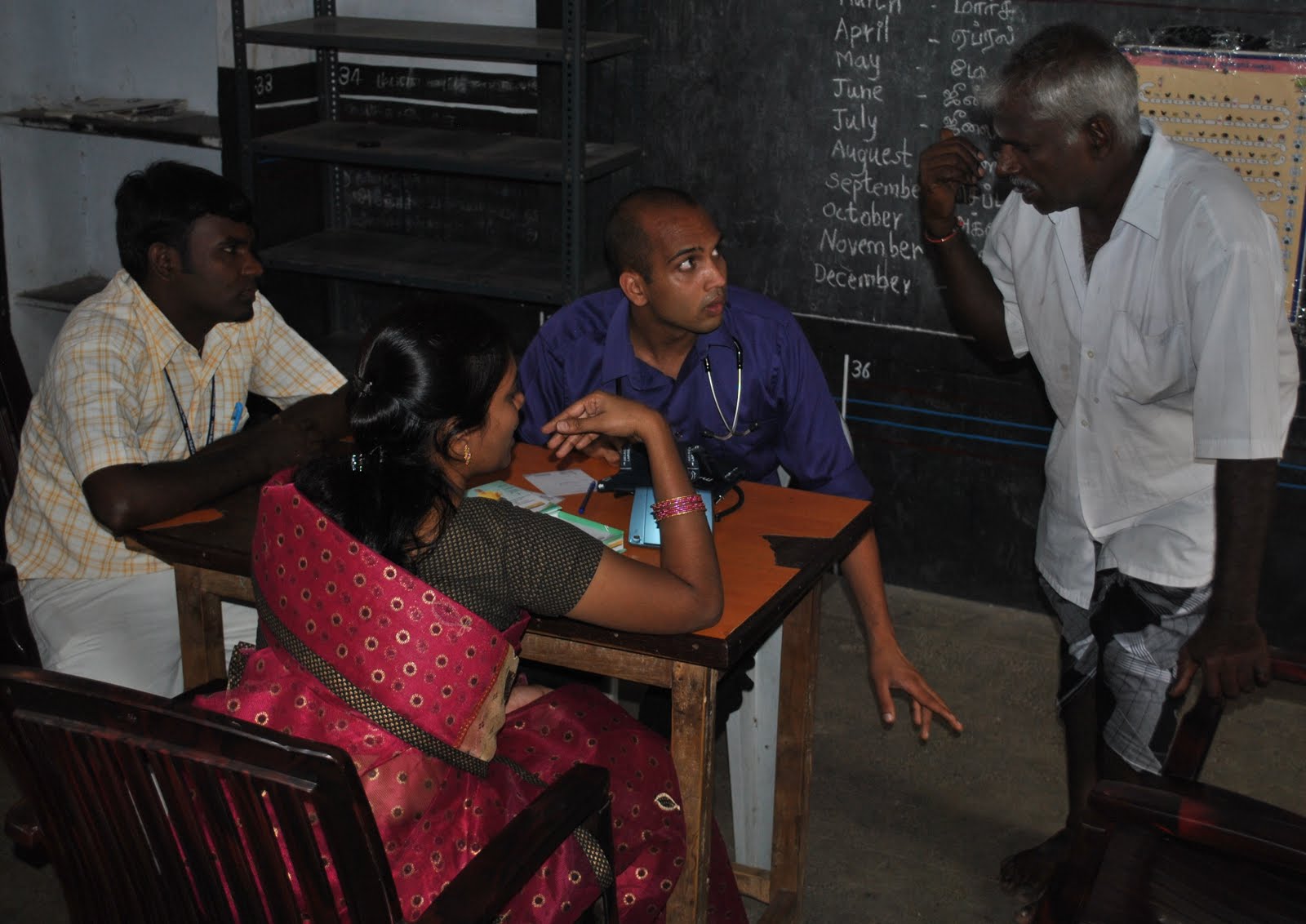
"Nalla irukkingala" (How are you?). I was trying to figure out how this gentleman hurt his feet. Shobana (pink sari) is translating for him. She's "nalla" (very good).

We had advertised the camp (the common Indian term for a community health screening) on Saturday and were expecting about 600 people to show up. The turn out was still unbelievable-- 155! Kartik, Shobana, and I were talking to the patients and listening to their complaints. We checked their blood pressure, looked for anemia induced pallor of their eyes, and dispensed acetaminophen, anti-histamines, mutlivitamins, and calcium as we saw appropriate. I even prescribed antibiotic creams to a couple of people, notably to someone who probably had a mild case of Hansen’s disease (leprosy) and had some infected wounds on his feet.


Kartik talked to the eutherian sabre tooth tiger's share of the patient load (sorry, inside joke).

Kartik, Dr. Rama’s son and the chief medical officer of the event, handled the majority of these patients on his own. I think I may have seen about 20-30 with Shobana helping me out with the translations. Dr. Bala also made me practice doing blood draws so I did about 25 of those, oftentimes with people crowding around me to witness the grotesque spectacle of blood spurting into my vacutainers. Some of the children stood so close to me that their little heads got in the way of my hands as I tied the tourniquet and changed containers.
Drawing blood from a particularly hard case. Third time was the charm.

We only had a few minutes with each patient and it was very frustrating for me not to be able to properly investigate the aches and pains that the patients brought to me. Moreover, as Kartik pointed out to me, it wouldn’t do them much good. He insisted that many of them, like a gentleman, who sported a white beard that matched his white kurta and seemed to be showing signs of Parkinson’s disease, wouldn’t be able to afford the treatment. For similar reasons, we found ourselves unable to do very much for a gentleman who came to us with blurry vision and jaundice. When we listened to his heart, through his disheveled red checked shirt which was only buttoned in two spots, we heard a pretty clear mitral valve regurgitation. The edema (swelling) in his feet, probably due to his heart condition, was so gigantic that Kartik initially thought he had Elephantiasis (a condition aptly named because your legs and arms can swell to a freakish degree and resemble the limbs of Elephants). We just had to let them go, knowing what fate held in store for them.

One of my motivations for getting into medicine was that I didn’t want to stand around helplessly when someone was sick. And yet, I was forced to watch indignantly as the gentlemen with Parkinson’s shuffled away from me: “Damn it! I knew how to treat him! Why the hell can’t I or someone else treat him?” This happened again and again and if there was a lab test for cynicism, a blood sample from me at the end of the camp would show trace bits of it today. Change is needed...and fast. It’s up to our generation of physicians and economists to facilitate it. I’d rail more, but I’m exhausted and I don’t want to devolve into melodrama.

Hopefully, one day, I’ll be able to say “Kavalai padadhinga, sari agidum” and believe it.

Suresh, phlebotomist par excellence, did at least 100 blood draws today and came to my rescue at least twice.

-----------
In less depressing news, it rained in Vellore today which gave us all a respite from the heat. I was walking to the canteen for some Uttapam when I kicked a frog accidentally. As I watched it complete its parabolic trajectory, a thought made me feel sick. Rains meant frogs and frogs meant snakes. Oh dear!

By “Oh dear”, I really mean “OMG, I don’t want to be eaten by a gigantic Krait that chooses to creep into my room or snare me while I am galloping back for a second slice of truffle cake at the college store! I much preferred the hot vellore sun which nearly solved Indian agriculture’s irrigation issues by inducing torrents of sweat from my body to this stupid monsoon that brings me monstrous serpents.”

As Tintin would say: “Great snakes!!!”

Saturday, June 25, 2011

I for Iodine

Date: 06/25/2011

“Medicine is a social science and politics is nothing more than medicine on a larger scale.”-- Rudolf Virchow
My study of public health in India began in All India Institute of Medical Sciences (AIIMS) in New Delhi (marked on the map). While in America, I had a serendipitous reconnection with Ritwik Pandav who was my best friend in third grade. His father, Dr. CS Pandav, is the head of the Department of Community Medicine at AIIMS and an expert on Iodine deficiency disorders (IDD). Dr. Pandav very graciously invited me to an intra-departmental symposium where I got an excellent primer on the principles and practice of community medicine and public health in India. Today I want to blog a bit about Iodine deficiency which was a big part of our discussions.
This image (courtesy Zimmermann, Jooste, and Pandav, 2008) tells the story of this little girl from western China who suffers from IDD. SHe has severe mental retardation and stunting. Some common facial features you can see here are the widely spaced eyes, saddle nose deformity, immaturely developed jaw bones, and thickened and dried skin and hair. I keep her face in my head when I think of Iodine deficiency disorder.


Iodine deficiency has been a much researched topic at AIIMS since the work of V. Ramalingaswami, a giant in the field, in the 1970s. Iodine deficiency in children can begin while they’re still in the uterus. Iodine is necessary for the production of thyroxine in the thyroid gland. Thyroxine is necessary for both the development of the brain and the body. It is important in the formation of myelin sheaths, which insulate the brain cells, in the brain and the spinal cord as well as the formation of connections between brain cells (synapsis) in foetuses and children. Severe iodine deficiency, unsurprisingly, results in mental deficiencies, physical stunting, and spasticity. Indeed, there is a 13 point difference in the IQ of children in Iodine deficient and Iodine sufficient areas of the country! This, coupled with physical stunting, leads to a very significant difference in income.
Fortunately, these deficiencies are reversible in childhood (to a certain degree) by correcting the iodine deficiency. In fact, the Disease Control Priorities Project (DCPP) suggests that the iodination of salt is an excellent investment. It involves an investment of 5 cents per child per year. When making policies in public health, we consider a concept called Disability-Adjusted-Life-Years (DALY) which is a measure of the the number of years of life lost through the morbidity and mortality of disease. If you value each DALY at $1000, salt iodization gives you a 30:1 benefit: cost ratio-- a smart idea (see the DCPP table below).
Ensuring the adequate iodine intake of the population involves frequent testing. T3, T4, and TSH tests are not sensitive tests. Urinary iodine concentrations are therefore used to assess iodine sufficiency. A concentration above 100 ug/L , which indicates an iodine intake of 150 ug per day, is considered sufficient. Pregnant women should consume about 250 ug of Iodine everyday (150-249 ug/L of Iodine in urine). Excessive consumption of Iodine yields a urinary output of 300 ug/L (500ug/L in pregnant women). Another direct test for severe Iodine deficiency is looking for goitre, an increase in the size of the thyroid gland.
This image (courtesy zimmermann, Jooste, and Pandav, 2008) shows an incredibly large goitre. The requirement for goitre to be diagnosed, ordinarliy, is that each lobe of the thyroid gland in the neck is larger than the size of the distal phalanx of the thumb (the tip-most bone of the thumb).

There was also some discussion of the salt iodination programme in India. Apparently, the government of India had placed a ban on the sale of non-iodized salt in the country in 1997. However, elements in the medical community raised concerns regarding the side effects of Iodine overdose and the government ended the ban in 2000. Consequently, the fraction of households using iodized salt fell by 12% (Zimmermann, Jooste, and Pandav, 2008) Fortunately, researchers-- spearheaded by those at AIIMS-- proved that the horrors of IDD eclipsed the possibility of over-iodination. As a result, the government reinstated the ban in 2005. Considering the devastation Iodine deficiency wreaks on human capital through its effects on physique and cognition, I find it deeply disturbing that more than 17 million south asian children are born in houeholds that are not protected by iodized salt every year.
Amartya Sen describes poverty as an individual’s incapability to realize his or her full potential as a human being (as cited in Banerjee and Duflo, 2011). If we accept this description, correcting iodine deficiency disorders is a key step in reducing the poverty of our world. Zimmermann, Jooste, and Pandav underline the importance of educating political leaders and forming public coalitions to address this issue. This responsibility falls largely on the shoulders of doctors who are, after all, public intellectuals. The more I proceed in my medical education, the more I feel that our battle is not so much against disease as it is against poverty.


"Only in India" moments:
I was walking in the street when I saw a scooter hurtling towards me. I leapt aside with a yell to avoid being mown like a helpless lawn.
Pranay: Dekho Dekho! (Watch out!)
Scoter driver: Arrey, side hato na! (Why the hell don’t you get out of the way instead of yelling?)
Ah, I love my country.

Sources:
  1. Zimmermann, MB, Jooste, PL, and Pandav, CS. Iodine deficiency disorders. The Lancet: 372 (2008)
  2. Alderman, H. Stimulating economic growth through improved nutrition. Disease Control Priorities Project (dcp2.org) (2008)
  3. Banerjee, AV and Duflo E. Poor Economics. Random House India. 2011

Friday, May 27, 2011

Cast of characters part 1

Date: 5/27/2011

Dr. Guerrant and I
I thought it important to introduce the cast of characters on this side of the Atlantic. First comes the man who sparked my interest in the connection between malnutrition and cognitive development: Dr. Richard Guerrant. It was his pioneering work in Brazil that first aroused my interest in studying this topic in Indian populations. Dr. Guerrant has been a frequent victim of my angsty ravings about how little some people are affected by the horrors of childhood malnutrition and health disparities in impoverished regions of our world. He has attempted (and mostly succeeded) to calm me down about this .

Another person who has greatly guided me and shown a lot of patience with me is Dr. Rebecca Dilllingham (pictured below). If I can ever develop a bedside manner half as warm as hers, I'll consider myself a very lucky man.

Dr. Dillingham in her office at UVA
The grant that made this possible was given to me by the Center for Global Health at the University of Virginia where I am enrolled in the school of medicine.

This is the brand new medical education building at the University of Virginia.
Last, but not least is April Ballard who guided me through the tortuous rigmarole of the grant application process and helped me get the grant despite my discreditable adoption of Douglas Adams's attitude towards deadlines: "I love deadlines. I like the whooshing sound they make as they fly by." She refused to let me photograph her, but I'm going to do my best to convince her in the coming weeks.


Friday, May 20, 2011

The story begins


Date: 5/20/2011

This photo of an Indian sage with a duffel bag waiting for a bus was taken in Jangpura, New Delhi in Summer 2010. I was taking a relaxing break before beginning med school.
I'll keep things brief here. I am an Indian medical student at UVA and just won a research grant to go and study malnutrition's impact on cognition at Christian Medical College, Vellore, India. This means much more than a free trip home for me. It's my first real step in the world of global health policy after an academic career devoted to basic science research. Considering, I hope to have an impact on the health care policy of underdeveloped regions of India and other developing countries, this is a very big step for me.

I'm really excited and hope to document the experience comprehensively out here. Sometimes, I might post things before I have fully processed stuff in my head. Please excuse me.


Om Ganeshaye Namah.

Vande Matram!