Know you blogger

My photo
Vellore, Tamil Nadu, India
I'm a frood who knows where his towel is.
Showing posts with label Leprosy. Show all posts

Friday, July 29, 2011

A hands on experience with Leprosy


Date: 07/29/2011

Her hands were the first thing I noticed. The nails were of many different abnormal shapes. Some were quite dirty. The fingers all curved inwards, incapable of stroking the soft cheek of her grandson or holding a glass of water on a hot summer day in India. Some of the fingers were swollen and many bore scars-- some healed others in the process of doing so. I felt extremely aware that I was in the presence of an ancient disease. It felt bizarre. The scabs on her fingers seemed incongruous. We are in 2011. Hadn’t we dealt with this scourge already? 
I can't believe this happens in 2011!


The long auto-ride to the place had been immensely bumpy and there were many moments when I thought I was going to fall out of the auto, but I was finally at the Shieffelin Leprosy Research and Training Centre in Karigiri near Vellore, an edifice for India’s long struggle against Leprosy. It was here that the famous Dr. Paul Brand, an amazing figure in the world of Leprosy and surgery, had first done the extensor-flexor four tailed tendon transfer to return some function to hands like the one in the picture above.  Once there, I met the director Dr. Mannam Ebenezer, an orthopaedics surgeon who specializes in operating on bone deformities due to Leprosy. He directed me to Dr. Jyothi Nirmala. Dr. Jyothi was absolutely fantastic. She started out by grilling me on my knowledge of Leprosy. I felt really glad that I had managed to finish the Harrison’s chapter in the auto so I didn’t look like a complete idiot. Subsequently, she showed me how to palpate the nerves that are typically inflamed in Leprosy and examine some of her patients who presented with different stages of Leprosy. I must admit it was initially difficult for me was to act perfectly detached in front of the patients and not allow the emotions deep within my heart to bubble to the surface. I am glad I managed it. The last thing they need is a person in the medical setup to react with horror when confronted with their cosmetic devastation. I made it a point to touch them on the arm when I said "Nandri" (thanks) to them after they agreed to being photographed. 

This wretched bacterium, not God's wrath, gives people Leprosy.
Image courtesy: www.pathmicro.med.sc.edu

You see, Leprosy is really a bacterial disease of the nerves. Mycobacterium leprae is really the weakling cousin of the notorious M. tuberculosis. Indeed, they’re so similar that the BCG vaccine for tuberculosis also protects us from leprosy according to some studies. M. leprae likes to attack nerves in the cooler peripheries of our body like the skin, the eyes, and the testes. Unlike M. tuberculosis, it’s not very effective at establishing an infection at all. In fact, 95% of us are naturally immune to it. It hasn’t yet been established what makes 5% of us vulnerable to infection. It has to do with some impairment of a branch of immunity called cell-mediated immunity (CMI). I suspect that there’s a genetic component to this susceptibility. Even then, it takes 7-12 years of contact to contract the disease and the incubation period can range from 2 months to 40 years. Shaking hands or having lunch with a leprosy patient will not give you leprosy. The exact mode of spread hasn’t been definitively established yet, but the infectivity is low and the spread of the disease slow.
Leprosy presents classically with a depigmented patch of the skin. There is some loss of sensation in these patches because Leprosy, remember, attacks the nerves. Based on the number and shape of the skin lesions and some other markers, the disease can be graded from the most controlled and limited (tuberculoid) to the most diffuse and poorly controlled (lepromatous). The major problems and deformities occur because of the nerve damage. Patients don’t realize when they get hurt and the consequent injuries accrue into deformities. For instance, cooking is a real hazard for people with leprosy because they don’t know when they’re touching something hot. This is why Dr. Jyothi provides them with microcellulose rubber gloves to wear on their hands while working to prevent injury. The injuries can lead to profound ulcerations that can be cosmetically disfiguring. They are also provided custom made shoes to avoid further injuries to their already deformed feet. 

This poor man got injured while tending his cattle. He didn't notice the injury
because of his lack of sensation and the small injury grew into this massive ulcer. 

The bacterial attack on the nerves can also result in deformities directly. For instance, the attack on the ulnar and median nerves in the arm causes the clawing of the hand as seen in the picture above and peroneal nerve degeneration in the leg results in foot drop and difficulty walking. Another serious deformity occurs when the nerves to the orbicularis oculi get injured in Leprosy. The patient is unable to close his eyelids fully even when he’s sleeping! As a result, the cornea dries out and this can lead to blindness. 
How can this foot be comfortable in a normal shoe? It's not safe for them to walk barefoot.

It’s really important to note that the disfiguration that stigmatizes Leprosy is the result of nerve damage, not a direct attack of the bacteria on the skin. Therefore, it becomes important to start the antibacterial therapy as quickly as possible to prevent the permanent loss of sensation and the contractures of the fingers.

A granuloma in which the cells of the immune system are walling
off bacteria from the rest of the body so that they cannot spread to other
sites. Image coutesy: humpath.com

As I mentioned before, our body depends on its cell mediated immunity (CMI) to deal with leprosy bacteria that hide within our cells. The CMI response prevents intracellular bacteria like M. tuberculosis and M.leprae from spreading around by walling them off in structures called granulomas.If our body has a strong CMI, it favours tuberculoid leprosy with very few well circumscribed lesions, but, when it gets weak, the bacteria spread and produce the lepromatous type of infection which is far more infectious, not to mention deformities accrue with time. One of the precipitating factors for a weak CMI is actually malnutrition. Cegielski et al. described how a deficiency of proteins in a person’s diet can drastically weaken their CMI and predispose them to conditions like tuberculosis(1). Given the immense similarities in M. tuberculosis and M. leprae, I really believe that when patients with leprosy are ostracized by society and forced into abject poverty, the consequent malnutrition can decimate their CMI and push them from the rapidly treatable tuberculoid form towards the dreaded lepromatous form of the disease which is difficult to manage and treat. As I mentioned in a previous post, this creates a vicious cycle of fear. 
We just don’t realize how lucky we are.


I thanked Dr. Ebenezer and Dr. Jyothi for being such wonderful hosts and teaching me so much. Before I left, Dr. Ebenezer invited me to come back to do leprosy research in my senior year. This is an offer I’ll definitely consider very strongly. I hailed an auto and headed back to CMC. On the way, the auto zoomed over some train tracks so violently that I pitched sideways and nearly out of the auto. Reflexively, I grabbed one of the iron bars in the auto and managed to not tumble violently onto the tracks. As my heart rate returned to normal, I gazed at my strong fingers that enjoyed a complete range of motion. I couldn’t stop looking at them for a while. 

Disclaimer: The patient photos were clicked only after ascertaining consent. I deliberately didn't take any photographs with their faces lest they be stigmatized any further. 


Bibliography:

1. The relationship between malnutrition and tuberculosis: evidence from studies in humans and experimental animals. Cegielski, J.P., McMurray, D.N., International Journal of Tuberculosis and Long Disorders 8(3):286–298, 2004.

Thursday, July 21, 2011

The fearsome face of leprosy in India


Date: 07/21/2011


Being fond of superlatives, I use horrifying and terrifying quite flippantly and usually in a comic context. After meeting a patient with leprosy in one of the community health screenings, I decided to google the following term: “Leprosy pictures”. When I describe those pictures as horrifying and terrifying, I don’t believe that is an overstatement at all and humour is very far from my mind. As I browsed through the pictures of the faces and bodies marred by leprosy, they seemed a hybrid between a monstrous phantasm and a human. Indeed, the disfigurment of the face due to leprosy is described as leonine facies (lion face). Seeing this made the aetiology of the stigma and the mistreatment associated with leprosy perfectly clear to me. It was fear.  

A quick internet search about leprosy produced this article: http://southasia.oneworld.net/Article/laws-in-india-criminalise-leprosy

It contained a list of the anachronistic laws in the Indian constitution related to leprosy. Most of them date from the British Raj when leprosy was considered highly communicable and incurable. In fact, leprosy is immensely treatable and is not easy to contract since about 95% of us are naturally immune to Mycobacterium leprae, the bacterium that causes leprosy. In fact, 90% of the cases of leprosy in India are tuberculoid which is not as infectious as the infamous lepromatous leprosy. I’m still in the process of checking whether these laws are  in effect or not.The key points are as follows. Leprosy patients in India cannot:
  1. Get a driver’s licence.
  2. Ride in a train.
  3. Compete in local elections.
Moreover, numerous marriage laws pertaining to hindus and muslims consider the contraction of leprosy as just grounds for the dissolution of marriage. Considering the fact that leprosy tends to be a disease of the poor and the abandoned, these laws are by the wealthy against the marginalised poor, by the majority against a defenceless and very ill minority. Of course, these legal wrongs are not the worst problems for patients of this ancient disease. 
The social stigma is immense and even some very highly educated Indians I’ve talked to seem to be fairly ignorant about leprosy and its mode of spread. Indeed, even people who had leprosy as children and were cured without any deformity accruing are seen with suspicion and their job prospects suffer.
 (picture courtesy Wikipedia)


This is a picture of Mahatma Gandhi massaging the legs of a brahmin who had contracted Leprosy and was considered an outcast/untouchable as a consequence. The Mahatma took him in and changed his bandages personally in an attempt to de-stigmatize the disease. Why is it, then, that the people who call him Bapu (father) still force leprosy patients to live in isolated colonies reminiscent of the dark ages?


From the little bit of reading I’ve done so far, it seems, experts are quite unsure about India ever being able to eradicate leprosy. There are some scientific hypotheses behind this. My personal hypothesis for the continued survival of the disease in India is simple: fear. The fear of disfigurement leads people to banish leprosy patients from society and make them live in isolated communities instead of initiating prompt treatment. These poor people do not get treated and their leprosy progresses to the lepromatous stage at which they start losing limbs and getting disfigured. It is this scary face of leprosy that society sees and sustains the fear of the disease. Do you see the vicious cycle? I’ll write more once I’ve ascertained the status of the laws and visited the Schieffelin Leprosy Research and Training Centre at karigiri which is quite close to CMC. 
When asked what separates us from “lower” animals, the most frequent answer is reason. It is the absence of good reasoning that creates a milieu conducive to fear. Good reasoning requires true premises. As doctors, medical students, economists, and educated persons, we have the potential to be public intellectuals! It is our role, as those in the know, to provide our fellow citizens with good, accurate, and up-to-date information so that their premises can be better educated, their actions and laws less inspired by fear-- more human and more humane. 

Sunday, July 3, 2011

Helplessly yours


Date: 07/03/2011

“Kavalai padadhinga, sari agidum.”

I stumbled over these newly-learned words with obvious difficulty. I doubt I inspired an iota of confidence in the patients I said this to despite the flashy stethoscope slung over my shoulders to assure them that I am a denizen of the medical world. Shobana, a lovely nutritionist at CMC, had taught me a few useful Tamil phrases despite the hectic pace of the community health screening we was working in. I could now say “Sapttangala” (Have you had breakfast?) and “Unga pirachanai yenna” (What is your problem?). “Kavalai padadhinga, sari agidum” roughly translates as follows: I’m sorry to hear that. Everything will get better.

The problem was that I didn’t believe things would get better at all.

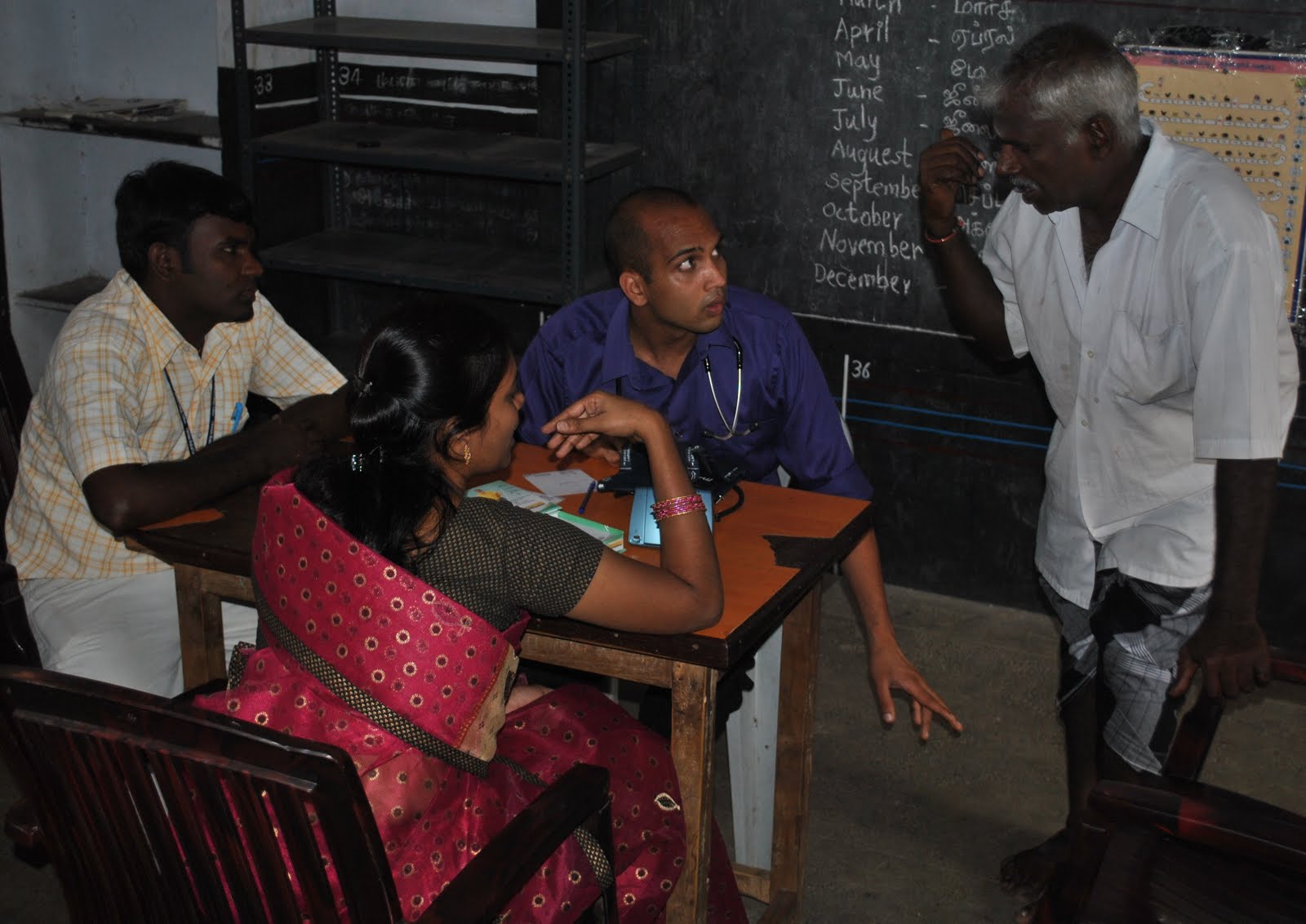
"Nalla irukkingala" (How are you?). I was trying to figure out how this gentleman hurt his feet. Shobana (pink sari) is translating for him. She's "nalla" (very good).

We had advertised the camp (the common Indian term for a community health screening) on Saturday and were expecting about 600 people to show up. The turn out was still unbelievable-- 155! Kartik, Shobana, and I were talking to the patients and listening to their complaints. We checked their blood pressure, looked for anemia induced pallor of their eyes, and dispensed acetaminophen, anti-histamines, mutlivitamins, and calcium as we saw appropriate. I even prescribed antibiotic creams to a couple of people, notably to someone who probably had a mild case of Hansen’s disease (leprosy) and had some infected wounds on his feet.


Kartik talked to the eutherian sabre tooth tiger's share of the patient load (sorry, inside joke).

Kartik, Dr. Rama’s son and the chief medical officer of the event, handled the majority of these patients on his own. I think I may have seen about 20-30 with Shobana helping me out with the translations. Dr. Bala also made me practice doing blood draws so I did about 25 of those, oftentimes with people crowding around me to witness the grotesque spectacle of blood spurting into my vacutainers. Some of the children stood so close to me that their little heads got in the way of my hands as I tied the tourniquet and changed containers.
Drawing blood from a particularly hard case. Third time was the charm.

We only had a few minutes with each patient and it was very frustrating for me not to be able to properly investigate the aches and pains that the patients brought to me. Moreover, as Kartik pointed out to me, it wouldn’t do them much good. He insisted that many of them, like a gentleman, who sported a white beard that matched his white kurta and seemed to be showing signs of Parkinson’s disease, wouldn’t be able to afford the treatment. For similar reasons, we found ourselves unable to do very much for a gentleman who came to us with blurry vision and jaundice. When we listened to his heart, through his disheveled red checked shirt which was only buttoned in two spots, we heard a pretty clear mitral valve regurgitation. The edema (swelling) in his feet, probably due to his heart condition, was so gigantic that Kartik initially thought he had Elephantiasis (a condition aptly named because your legs and arms can swell to a freakish degree and resemble the limbs of Elephants). We just had to let them go, knowing what fate held in store for them.

One of my motivations for getting into medicine was that I didn’t want to stand around helplessly when someone was sick. And yet, I was forced to watch indignantly as the gentlemen with Parkinson’s shuffled away from me: “Damn it! I knew how to treat him! Why the hell can’t I or someone else treat him?” This happened again and again and if there was a lab test for cynicism, a blood sample from me at the end of the camp would show trace bits of it today. Change is needed...and fast. It’s up to our generation of physicians and economists to facilitate it. I’d rail more, but I’m exhausted and I don’t want to devolve into melodrama.

Hopefully, one day, I’ll be able to say “Kavalai padadhinga, sari agidum” and believe it.

Suresh, phlebotomist par excellence, did at least 100 blood draws today and came to my rescue at least twice.

-----------
In less depressing news, it rained in Vellore today which gave us all a respite from the heat. I was walking to the canteen for some Uttapam when I kicked a frog accidentally. As I watched it complete its parabolic trajectory, a thought made me feel sick. Rains meant frogs and frogs meant snakes. Oh dear!

By “Oh dear”, I really mean “OMG, I don’t want to be eaten by a gigantic Krait that chooses to creep into my room or snare me while I am galloping back for a second slice of truffle cake at the college store! I much preferred the hot vellore sun which nearly solved Indian agriculture’s irrigation issues by inducing torrents of sweat from my body to this stupid monsoon that brings me monstrous serpents.”

As Tintin would say: “Great snakes!!!”