Know you blogger

My photo
Vellore, Tamil Nadu, India
I'm a frood who knows where his towel is.
Showing posts with label Tamil. Show all posts

Sunday, July 3, 2011

Helplessly yours


Date: 07/03/2011

“Kavalai padadhinga, sari agidum.”

I stumbled over these newly-learned words with obvious difficulty. I doubt I inspired an iota of confidence in the patients I said this to despite the flashy stethoscope slung over my shoulders to assure them that I am a denizen of the medical world. Shobana, a lovely nutritionist at CMC, had taught me a few useful Tamil phrases despite the hectic pace of the community health screening we was working in. I could now say “Sapttangala” (Have you had breakfast?) and “Unga pirachanai yenna” (What is your problem?). “Kavalai padadhinga, sari agidum” roughly translates as follows: I’m sorry to hear that. Everything will get better.

The problem was that I didn’t believe things would get better at all.
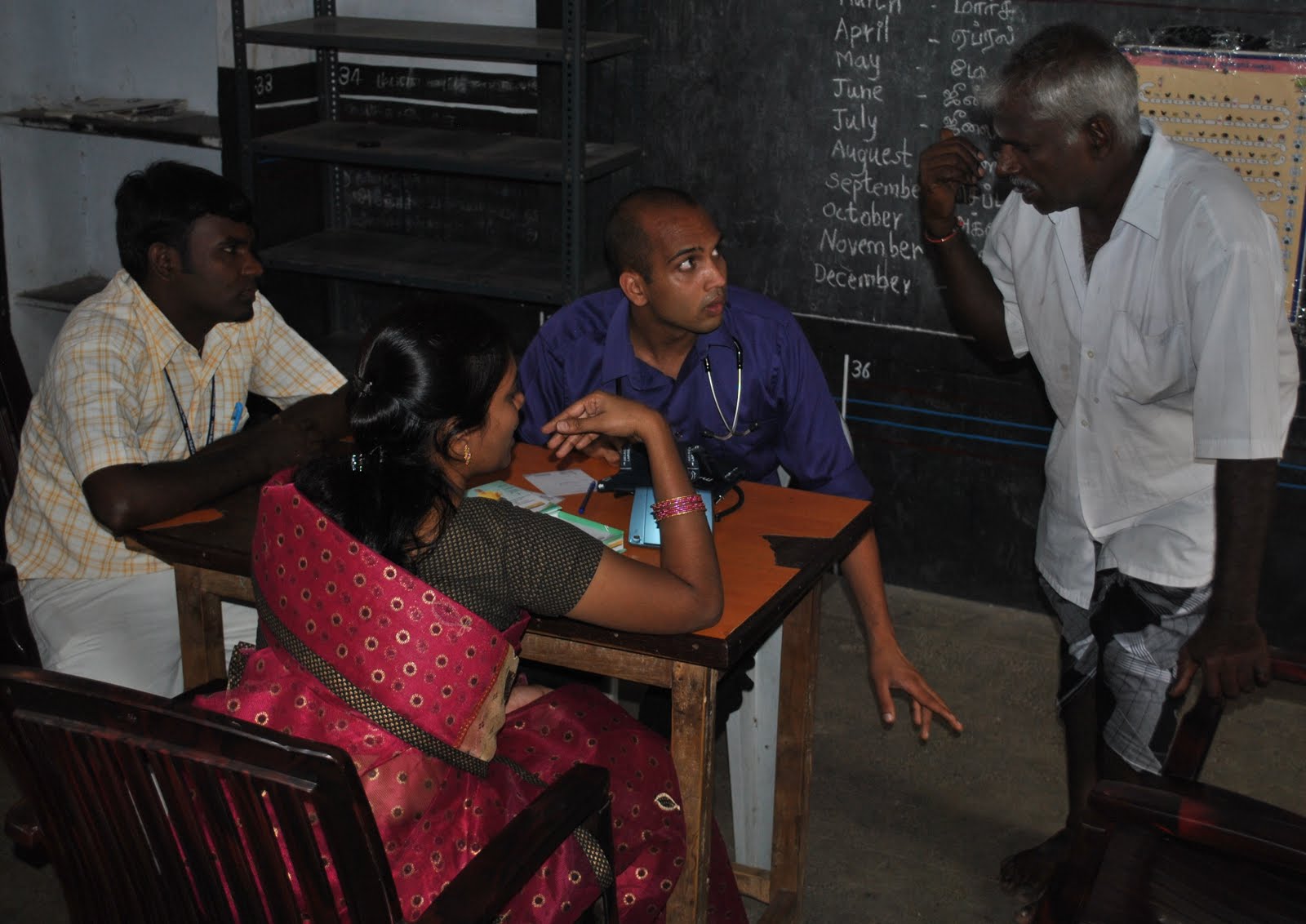
"Nalla irukkingala" (How are you?). I was trying to figure out how this gentleman hurt his feet. Shobana (pink sari) is translating for him. She's "nalla" (very good).

We had advertised the camp (the common Indian term for a community health screening) on Saturday and were expecting about 600 people to show up. The turn out was still unbelievable-- 155! Kartik, Shobana, and I were talking to the patients and listening to their complaints. We checked their blood pressure, looked for anemia induced pallor of their eyes, and dispensed acetaminophen, anti-histamines, mutlivitamins, and calcium as we saw appropriate. I even prescribed antibiotic creams to a couple of people, notably to someone who probably had a mild case of Hansen’s disease (leprosy) and had some infected wounds on his feet.


Kartik talked to the eutherian sabre tooth tiger's share of the patient load (sorry, inside joke).

Kartik, Dr. Rama’s son and the chief medical officer of the event, handled the majority of these patients on his own. I think I may have seen about 20-30 with Shobana helping me out with the translations. Dr. Bala also made me practice doing blood draws so I did about 25 of those, oftentimes with people crowding around me to witness the grotesque spectacle of blood spurting into my vacutainers. Some of the children stood so close to me that their little heads got in the way of my hands as I tied the tourniquet and changed containers.
Drawing blood from a particularly hard case. Third time was the charm.

We only had a few minutes with each patient and it was very frustrating for me not to be able to properly investigate the aches and pains that the patients brought to me. Moreover, as Kartik pointed out to me, it wouldn’t do them much good. He insisted that many of them, like a gentleman, who sported a white beard that matched his white kurta and seemed to be showing signs of Parkinson’s disease, wouldn’t be able to afford the treatment. For similar reasons, we found ourselves unable to do very much for a gentleman who came to us with blurry vision and jaundice. When we listened to his heart, through his disheveled red checked shirt which was only buttoned in two spots, we heard a pretty clear mitral valve regurgitation. The edema (swelling) in his feet, probably due to his heart condition, was so gigantic that Kartik initially thought he had Elephantiasis (a condition aptly named because your legs and arms can swell to a freakish degree and resemble the limbs of Elephants). We just had to let them go, knowing what fate held in store for them.

One of my motivations for getting into medicine was that I didn’t want to stand around helplessly when someone was sick. And yet, I was forced to watch indignantly as the gentlemen with Parkinson’s shuffled away from me: “Damn it! I knew how to treat him! Why the hell can’t I or someone else treat him?” This happened again and again and if there was a lab test for cynicism, a blood sample from me at the end of the camp would show trace bits of it today. Change is needed...and fast. It’s up to our generation of physicians and economists to facilitate it. I’d rail more, but I’m exhausted and I don’t want to devolve into melodrama.

Hopefully, one day, I’ll be able to say “Kavalai padadhinga, sari agidum” and believe it.

Suresh, phlebotomist par excellence, did at least 100 blood draws today and came to my rescue at least twice.

-----------
In less depressing news, it rained in Vellore today which gave us all a respite from the heat. I was walking to the canteen for some Uttapam when I kicked a frog accidentally. As I watched it complete its parabolic trajectory, a thought made me feel sick. Rains meant frogs and frogs meant snakes. Oh dear!

By “Oh dear”, I really mean “OMG, I don’t want to be eaten by a gigantic Krait that chooses to creep into my room or snare me while I am galloping back for a second slice of truffle cake at the college store! I much preferred the hot vellore sun which nearly solved Indian agriculture’s irrigation issues by inducing torrents of sweat from my body to this stupid monsoon that brings me monstrous serpents.”

As Tintin would say: “Great snakes!!!”

Friday, July 1, 2011

Confused in Chennai, Vacuous in Vellore

Date: 07/01/2011
A street view of Vellore
The cool interiors of the aircraft gave way to a tarmac that was bindingly bright and blistering at a 100 degrees Fahrenheit. With a groan, I shrugged off my black sports coat and boarded the bus that ferried me to the terminal. As I was exiting the bus, I heard an unintelligible (to me, at least) yell.

Lady: (insert white hot fury expressed in Tamil that made the tarmac look cool)

Me: (dumb look)

Lady: (angry gestures that I should let her spawn exit the bus first)

Me: Sorry!

As I let the kid and the lady exit the bus, I experience deja vu. I was in the South.

Vellore is marked with the red oval.


India is a massive country with 1.2 billion people. The country is divided into 28 states and 7 union territories. The states were created along linguistic lines. Each state is roughly the size of a European country so traveling between states is almost like traveling between different countries in that the language and the culture changes distinctly. The steepest divide lies between the northern states and the southern states due to reasons beyond the scope of this blog post.  I'm now in the southernmost Indian state of Tamil Nadu. The main language here is Tamil. It is one of the most educated and progressive states of India. There’s a widespread delusion among second generation Indians in the US and even some non-resident Indians that you can communicate with basically everyone in India if you speak Hindi and English. In my case, three days in Tamil Nadu have rendered any vestige of that belief dead in the water. More on this soon

My bus ticket to Vellore from Chnnai. Journey time: 2.5hrs
I took a bus from Chennai to Vellore and then was mobbed by auto drivers. Autos (as in Auto Rickshaws) are surely a conspiracy of some religious secret society to ensure piety among Indians. When you’re within an Rickshaw as it careens through Indian streets at imprudent speeds and brushes aside pedestrians who’re forced to run for their lives, you quickly abandon atheism/agnosticism and beg God to forgive your waywardness and get you home safely. A young lad in the mob of auto drivers finally out-shouted everyone and gave me an organ-rattling ride to my accommodations. He must have heard my liver rattling against my ribs so he decided to regale me with his life story and simultaneously practice his accented Urdu on me. He was the sole offspring of his parents and was married very early so he had no option but to forego education and take care of them by driving his auto. When we got to Bergen house (my guest house) I poured myself out of the rickshaw, gave him a generous tip (for not killing me and to take care of his pregnant wife), and began dragging my suitcases up the stairs. He rushed up and asked to make a request of me.

Me: What do you want?
Lad: Sir, when you’re a doctor, please charge the impoverished half the rate you charge the wealthy.
Me: Will do

The significance of the request was not lost on me. The impoverished fall ill more often and suffer great economic setbacks due to medical expenses, which-- in turn-- leads to more sickness. A real poverty trap. Esther Duflo and Abhijit Banerjee do a beautiful job of describing it in their book, Poor Economics. An interesting discussion of it can also be found in a report by Harold Alderman for the disease control priorities project.
Bergen House: my wonderful, though slightly pricey, abode in Vellore. It's on the CMC college campus pictured below.


The next day, I got a call on my room’s phone. A deep voice identified itself as Dr. Ramakrishna, my mentor at CMC. He’s the head of the Dept. of Gastroenterology and is involved in all sorts of brilliant project. He drove down a few minutes later to pick me up from Bergen House. Dr. Rama is a tall man who talks deliberately and takes a second to think before answering your questions in a lucid and well-considered way. Even his laugh is deliberate, deep, and rich. We began talking about the logistics of my project and talk turned to the state of healthcare in India. By the end of the ride ee were discussing the disorganization and the inadequacy of funds that plagued the public health system. India spends about 3% of its GDP on health. America spends about 17%. neither extreme is good. One of the interesting things Dr. Rama said during the ride was with respect to cancer. He said that India has a poor tumour directory because documenting tumours is very very far from his priority. When faced with the illness of a family member, Indians, particularly poor ones, are known to sell their lands and take outrageous debts. Therefore, his main priority is actually to prevent cut-throat money lenders, witch-doctors, and quacks from bleeding patients dry.


Christian Medical College (CMC): One of the finest medical colleges in India.

Having ascertained that I hadn’t had sufficient breakfast, Dr. Rama took me for a vada ( a delicious lentil based southern recipe) and delicious filter coffee. Drs. Pugazhendhi and Shrikanth accompanied us. Once we got our coffees and vadas, we sat at the table looking at each other with awkward smiles. Dr. Rama introduced an icebreaker


Dr. Rama: Do you pronounce your name the Bengali way (PranOY) or the other way (PranAY)


Pranay: PranAY.


This gave me the opportunity to rant about my appalling name. The ice was broken. Phew! We were all chuckling now. Next we talked about my complete incomprehension of Tamil.

Last year, I had brought my then girlfriend to India. It is only now that I understand her plight. She had been mostly dependent on me for translating the goings on even though she spoke a little Hindi that she’d learned from Bollywood movies and Rosetta stone. 


I, on the other hand, was utterly dependent on Dr. Rama and the other doctors for communicating with people. I felt like a complete moron standing around, not understanding a SINGLE word. I felt even worse when people broke off their high-speed conversations to explain the gist of the dialogue to me. They did this very slowly in case I didn’t understand even their English. Vettri, the driver who has been taking me around, probably thinks that I am mentally challenged because our conversations go as follows:
Vettri: (in Tamil) You need to go to that shop to get a passport picture.
Pranay: (thinking he’s asking me how I like Vellore) errr...very nice
Vettri: (now confused, still in Tamil) Umm...go to that shop over there, I’ll wait here.
Pranay: (thinking he’s talking about films) I’d love to watch a Tamil movie. English subtitles?
Vettri: (in heavily accented and broken english) Go to the damn shop now.
Pranay: (with my patented look of dumb incomprehension) Eh?
Vettri: (gesticulating furiously now) GO!
Pranay: (understanding finally dawns) Ok, ok, keep your shirt on.
I’m obviously kidding. Vettri has shown me the greatest politeness and tolerance. However, I do need to learn some Tamil to make things easier for the people I’m working with and the individuals I’ll be interviewing.
I’ll write more about the projects I am involved in in future posts. Watch this space. I’m also putting up pictures from the trip on my flickr photostream.

In India, the versatility of your vehicle is only limited by your imagination. Kudos to this gentleman in Chennai who had precariously balanced this old television on his motorcycle.